When ordinary rest is no longer enough.
Quantum Medicine and Ayurveda are combined within one personal recovery protocol. Prolonged exhaustion is not approached with a standard detox timetable here. The first question is simpler than that, and more useful: what can this person safely receive right now?
- Quantum Medicine and Ayurveda, read together
- One personal recovery protocol
- Reviewed and adjusted every day
Tired, but still unable to switch off.
Many people arrive describing something similar. They are exhausted, yet their mind will not fully settle. Sleep is light or interrupted, and waking rarely feels like waking up rested. Digestion has often become more sensitive or irregular than it used to be, and a low background of tension persists even during time that is meant for rest. Things that used to help, an early night, a weekend away, no longer seem to restore very much.
None of this needs a diagnosis to be real. It is what prolonged pressure tends to do to a body and a nervous system over time, and the team sees some version of it in most people who come for recovery. The starting point is not to label it. It is to find out, through assessment, what this particular nervous system, digestion and constitution can actually work with right now.
Deep detox is not always the first step.
A person who arrives significantly depleted does not always benefit from intensifying the process. Cleansing asks something of the body: digestive strength, tissue reserves, a nervous system with some capacity left to respond. Where those are limited, pushing ahead with a deeper procedure can work against what was intended, leaving someone more depleted rather than more restored.
So the first phase is not always detoxification. Depending on what the assessment shows, it may need to be preparation, stabilisation or straightforward nourishment before anything more active is introduced. Someone else, with steadier digestion and more in reserve, may be ready to move into active cleansing much sooner. Both are legitimate versions of the same process. They simply start from different places.
- Preparation
- Cleansing
- Restoration
For a person with sufficient strength and digestive capacity to move into active cleansing relatively early.
- Stabilisation
- Nourishment
- Carefully directed cleansing
For a person who is currently too depleted for that, and needs to rebuild capacity first.
Less intervention can sometimes be the more precise intervention. That is the principle behind how this phase is decided, and it is decided by assessment rather than by how the word detox usually gets used.
Neither reading stands alone.
Both readings are reviewed together, and it is that review, not a program chosen in advance, that decides whether preparation, cleansing or nourishment comes first, and how the protocol changes from there.
How the method combines the twoHow the two are actually used.
Quantum Diagnostics adds a reading of how the nervous system and recovery capacity currently present. Ayurveda supplies the therapeutic logic: digestive strength, current imbalance, and capacity for cleansing. Reviewed together, they decide whether cleansing begins now or waits, how full a given day should be, and which oils, herbs, food and Panchakarma procedures make sense for this person at this point.
One example makes this concrete without needing to stand for the whole method. If a frequency or bioresonance reading suggests a pattern that looks like heightened inflammation, that observation is weighed alongside the Ayurvedic findings when refining which oils, herbs, food or therapeutic media are used, favouring something cooling or balancing over the alternative.
How the method combines the twoSleep rarely arrives as a problem on its own.
In practice, poor sleep tends to travel with company: digestive sensitivity, irregular elimination, emotional pressure, overstimulation before bed, or a reduced capacity to settle after a demanding day. Treating each of these as an unrelated item, on its own track, misses how closely they tend to move together.
The assessment reads them as one picture. What the Quantum reading suggests about the nervous system, what the Ayurvedic reading shows about digestion and constitution, and what is actually observed day to day are held together rather than filed separately. Sleep can improve as digestion settles. Digestion can settle as the nervous system has more room to come down. There is rarely a single cause to isolate, which is why the review works this way.
Warm food, oils, rhythm and Panchakarma.
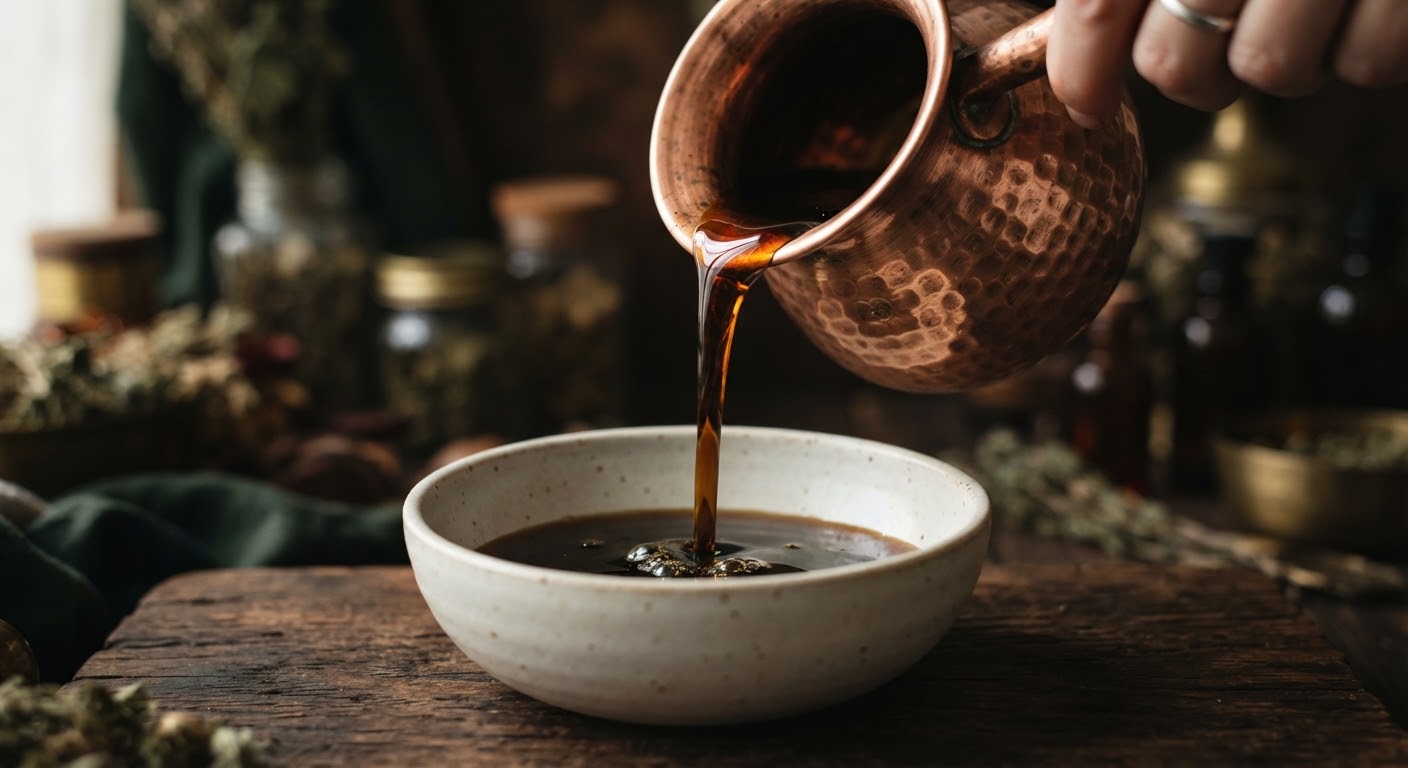
Much of what Recovery involves is fairly ordinary once you are inside it. Meals are warm and individually prepared rather than chosen from a menu, timed to support digestion rather than simply to fill a schedule slot. Therapeutic oils are selected for constitution, current imbalance and treatment goal, which is a different exercise from choosing something off a spa list. Herbs and teas are directed at digestion, sleep or the nervous system, depending on what is needed.
Where appropriate, Panchakarma procedures are introduced and sequenced according to readiness rather than a fixed weekly plan, and Rasayana, the Ayurvedic approach to restoration and long-term vitality, plays a part for people moving into the later stage of the process. Underneath all of it sits rhythm: regular timing for meals, treatment and rest, because an erratic schedule works against a nervous system in much the same way disturbed sleep does.
Frequency work, coordinated with the Ayurvedic plan.
Recovery also draws on the Quantum Medicine side of the method. Personalised frequency programs, bioresonance based work and other technology supported sessions may form part of the protocol where appropriate, selected for the individual and coordinated with the Ayurvedic plan rather than run as a separate track. What one person receives on a given day is unlikely to match what someone else receives, or what the same person receives a week later.
This is not a catalogue of devices to select from. Which sessions are used, and when, is decided the same way everything else is: through assessment and daily observation.
Pressure does not always end when the demands do.
Pressure that has built up over months or years does not always resolve once the external demands stop. It can carry on quietly by itself, showing up as tension that will not release, a mind that stays busy even in a quiet setting, or a stress response that feels automatic rather than chosen. Where this is relevant, the protocol may include mind coaching, hypnotherapy, regression work or exploration of established emotional and behavioural patterns, led within Siniša Kruška's professional scope.
This sits alongside the Ayurvedic and Quantum elements of the protocol, not apart from them. It is not offered as psychotherapy, and it does not rest on the idea that every physical complaint traces back to emotional trauma. For some people it turns out to be a meaningful part of what recovery involves. For others it is a smaller piece of the picture, or not needed at all.
What today looks like depends on what yesterday showed.
- Food
- Therapeutic oils
- Herbs
- Frequency programs
- Panchakarma sequence
- Treatment intensity
- Rest
Rest can become more important than the next scheduled therapy, and a deeper procedure can be delayed if the body is not ready for it yet. None of this is decided once, at the start, and then left to run on its own.
The plan follows the person.
Seven days, or ten to fourteen.
The minimum stay is seven days. For deeper exhaustion, a longer-standing complaint, or a process that needs more care in how it is sequenced, ten to fourteen days is generally preferred, and selected programs extend to fifteen. The right length is recommended after the initial consultation, not chosen from a brochure beforehand.
More time is not simply more treatment stacked on top. In practice it usually means:
- Slower preparation before anything deeper is attempted
- Gentler pacing between therapies
- Better sequencing as the response to each phase becomes clear
- More observation before a decision is made
- Room for cleansing to be followed by proper restoration, not just a closing note
- A more stable transition home
It changes how much room there is to get the sequencing right, not how much is being done to you.
Recovery does not always mean detox.
It is worth saying plainly. The word detox does not describe everything that happens under Recovery. One person may need more cleansing. Another may need more nourishment. A third may need sleep, rhythm, warm food and rest before anything else is even considered, and might move through several of these phases within a single retreat. Recovery is the wider process; detox, where it happens at all, is one part of it, not a synonym for the whole.
Some people who come for Recovery move on, once stability improves, toward Longevity and Rasayana and longer term vitality. That is not a separate program. It is the same method, continuing in a different direction as the original reason for coming resolves.
Recovery is why. Group, Private or Master is how.
Recovery and Deep Detox describes why someone is coming, not how private or flexible the retreat should be. Any of the three formats, Group, Private or Master, can support a Recovery protocol; the assessment helps determine which one, and which location, fits best.
Compare retreat formatsParticipation is reviewed, not assumed.
Q Ayurveda is selective rather than open to everyone who applies. People with serious, acute or unstable conditions, complex medication, recent surgery or significant medical risk may need medical clearance before acceptance, or may be better served by a different level of care. This is discussed directly and early, as part of the initial assessment, not left until arrival.
Safety and suitabilityBefore, during and after.
- Before
Assessment and preparation
Preparation can begin weeks before travel: a private assessment, a review of health and lifestyle, a preliminary evaluation, and, where relevant, some dietary or herbal preparation beforehand. A remote complementary assessment may also be arranged ahead of arrival.
- During
Quantum Medicine, Ayurveda and daily review
Both readings are reviewed from the first day and translated into your protocol: individual food, oils, herbs, Panchakarma where appropriate, frequency programs, selected technologies and mind coaching where relevant. The plan is reviewed again every day that follows.
- After
Closing review and home protocol
A closing review, individual recommendations for home, and a follow-up usually arranged after three to four weeks. Where appropriate, assessment is repeated and the home protocol refined from there.
Support, not a promise.
Individual experiences vary, and nothing here is offered as a cure for burnout, a reset for the nervous system or a guarantee of better sleep. What the process aims at is more modest and, most of the time, more useful than that: a system that copes better than it did before, assessed and adjusted the whole way through.
- Recovery capacity
- Sleep rhythm
- Digestion
- Resilience
- A calmer daily rhythm
- Energy management
- Restoration after prolonged pressure
Answered directly.
- What is the Q Ayurveda Recovery and Deep Detox retreat?
- It is a personalised retreat for people dealing with prolonged exhaustion, disturbed sleep, digestive imbalance, chronic tension or a nervous system that no longer settles easily. Quantum Diagnostics and Ayurvedic assessment are reviewed together to work out what the person actually needs first, whether that is preparation, cleansing, nourishment, restoration, or some combination, and the protocol is adjusted daily from there.
- Is this a standard detox program?
- No. Some people benefit from deeper cleansing fairly early. Others are too depleted for that and need stabilisation and nourishment first. The word detox describes one possible phase of the process, not the whole of it, and the sequence is decided by assessment rather than assumed in advance.
- Does everyone receive Panchakarma?
- Not automatically, and not in the same form. Panchakarma may form part of the protocol where digestion, strength and stability support it. For someone who arrives significantly depleted, the earlier days may focus on nourishment and rhythm instead, with cleansing introduced later if and when it becomes appropriate.
- What if I am too exhausted for deeper detoxification?
- That is exactly the situation the initial assessment is designed to catch. If cleansing would be too much too soon, the protocol begins with preparation, stabilisation or nourishment instead. Nothing is intensified simply because a program calls for it.
- How do Quantum Medicine and Ayurveda work together in recovery?
- Quantum Diagnostics, the complementary bioresonance and frequency based assessment, adds a further layer of information about how the person is currently functioning. Ayurvedic assessment covers constitution, present imbalance, digestion, elimination, sleep, energy, tissue condition and nervous system state. The two are read together, and the combined picture is what actually shapes the protocol.
- Can the protocol become gentler during the retreat?
- Yes, and this happens often. If observation shows that rest matters more than another procedure on a given day, the plan is adjusted that day, not at the end of the week.
- How long should a Recovery retreat last?
- The minimum is seven days. Ten to fourteen days is generally preferred for deeper exhaustion or a more chronic picture, and selected programs may extend to fifteen. The right duration is recommended after the initial consultation, not fixed in advance.
- Is seven days enough?
- For some people, yes. Seven days is enough time to open the assessment properly, begin a protocol and see an early response. For prolonged exhaustion or a more complicated picture, more time usually allows a steadier sequence rather than a compressed one.
- What is the difference between rest and recovery?
- Rest is stopping activity. Recovery is whether the body and nervous system can actually use that pause to restore capacity, which depends on digestion, sleep quality, nervous system state and a number of other factors. Someone can rest for days without recovering much, which is often exactly why they are looking for something more structured.
- Can I attend if I take medication?
- Often, yes, though this is reviewed individually. People with serious, acute or unstable conditions, complex medication, recent surgery or significant medical risk may need medical clearance first, or may be better suited to a different level of care. This is discussed openly during the initial assessment.
- How do I know whether I need cleansing or nourishment?
- You are not expected to work that out yourself. That is what the assessment is for. Quantum Diagnostics and Ayurvedic assessment, read together, indicate which direction is appropriate to start with, and the plan is revised as the retreat goes on.
The question is not how much detox you can tolerate.
It is what your system needs first. Tell us what you are dealing with and how long you can dedicate, and we will review whether Q Ayurveda™ appears suitable.
Participation is selective. The assessment helps determine suitability, intensity, duration and retreat format.